(Once again, I apologize if this sounds dry and academic; it's an ongoing project that I am working on, a paper as yet incomplete. At the risk of sounding pompous, it hasn't been published yet, so I would appreciate discretion.It's too long, so I've shortened it as much as possible)

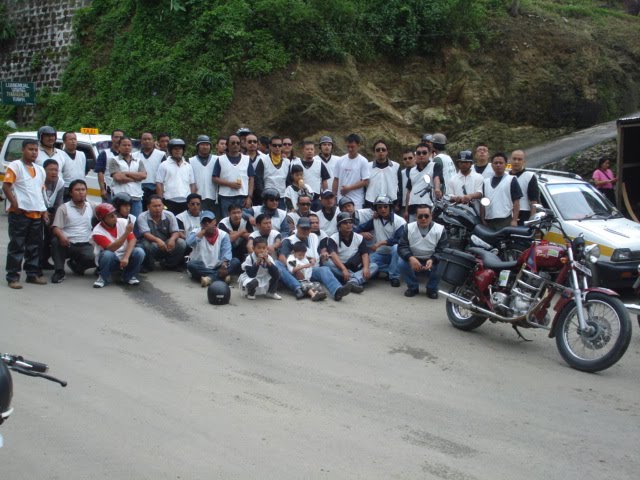
In Aizawl, Mizoram, in the year 1999, a group of bikers who rode Royal Enfield Bullet bikes came together, and taking their cue from American biking clubs that they had heard about (specifically Hells Angels), decided to call themselves the Royal Enfield Bullet Riders, and went on their first ride on November 5, 1999. There were only a handful of riders then, and most of them rode second-hand bikes that had been reassembled, repaired, and remodeled. Their enthusiasm and their obvious love for the machines they rode made up for any other lack in terms of numbers and equipment. They were later to be officially recognized as the first Bullet Club in India by the Royal Enfield Company, the manufacturers of the bikes they rode.
As the rides continued, their numbers also gradually grew, and by 2002, they had grown to the point where the necessity of electing leaders for the Club was felt. Leaders, called Chiefs, were thus elected, and the Club was also renamed The Aizawl Thunders, a name suggested by one of the founding members, Rinchhana.
Over time, the Thunders evolved into a group that was organized along coherent lines, with proper rules of conduct, identifiable modes of attire, and activities stretched beyond the bike rides in open countries to charity rides for specific causes. They chose deep blue and red as their official colors, and the phrase, “Forever Young” became their motto. Stickers with the Thunders logo were distributed to members, bearing the year of membership, which incidentally, was to be renewed each year, and T-shirts were designed and distributed amongst members of the group.
In 2003, a Constitution was framed by the Executive Committee members of the Thunders, and in accordance with their Constitutional framework, elections are democratically undertaken annually, and in 2006, it was agreed that three Chiefs would be elected at each election. These three Chiefs would then distribute the responsibilities of leadership amongst themselves. Early activities included rides mainly, and after they grew in the number, they would often hire themselves out as security personnel in concerts and parties, which they have since stopped doing.

The bikers have their own lingo, certain words and phrases that provide no meaning to those outside the group. For instance, the word, “Sootpoot”, which contains sexual innuendo (for them), is used as an adjective, a noun, and a verb, and usually denotes something or somebody attractive. If a woman is described as ‘sootpoot’, it is meant to be a compliment; if a biker is up to some ‘sootpoot’ he is either flirting or up to some mischief with a woman, and so on. Members address each other as “Boss Boss”, a term of respect. The bikers also have certain songs they sing when they go out on rides or gather for social events, the lyrics of which are deliberately silly and in reference to certain activities and adventures they have encountered. One of their songs tells of the bikers’ encounter with a village lass on one of their trips. She is simply referred to as ‘Two-cell battery’ because she apparently owned a flashlight with a two-cell battery, of which she was inordinately proud, and rightly so, for when night fell, the village was enveloped in darkness due to power failure, and her flashlight came in very handy. When the trip was over and they sat down to relive their experiences, it was discovered that most of the bikers on that trip had ‘sootpooted’ with her over the course of the night they spent in her village. The song mocks their own gullibility, and pays homage to her artful ways. The chorus simply celebrates the “two-cell battery” girl.

In so far as the experience of the bike ride is concerned, a common theme amongst those who were interviewed was the thrilling sense of power given by the throb of the engine as it effortlessly maneuvers terrain of all kinds. The identity of the biker melts into that of the bike, until man and machine seem to be one. His machine, then, becomes an extension of his personality; conversely, he becomes an extension of the unleashed force of the machine. On foot, the biker is like any other man. Seated on his powerful machine, he is wild beast, conqueror, powerful regent, warrior, bird, man, god, machine, and wind. Members have also shared that the rhythmic, thumping sound of the bike itself invokes a response in them which is intense. Yet another analogy is drawn between the riding of the bike and that of a powerful horse.

Other members have similarly close relationships with both their bikes and the Thunders Clan. Some members have christened their bikes with female names such as ‘Rosalyn’, and refer to them as such. The clan seems to provide its members with a valid identity that they are proud of. This sense of belonging, this claim to a valid identity, is reinforced by tangible evidence of membership within the specific community, such as the attire that is worn by them – leather jackets, official black t-shirts, tight jeans and leather boots- and Thunders paraphernalia such as logos, stickers, and so on. The male bonding that takes place is as much an affirmation of their solidarity and affiliation to the clan, as it is also a safe harbor that ascertains each member’s significance and worth. In other words, for many, it is the only real identity they have, in that it is one that is voluntarily embraced by them, as opposed to other roles that they play within societal institutions.

Interestingly, the Aizawl Thunders have also succeeded where most Biker Clubs have failed or have not been bothered to try. Like most biker clubs, certain assumptions abound as to the nature of the identity presented by their Biker community. Certainly, the standard attire, greasy long hair gathered in a pony tail, the smoking, drinking and womanizing, the flouting of social norms and conventions often associated with their counterparts in the west also make their appearance within the Thunders. However, almost from the very beginning, the leaders of the clan have had very clear visions as to the direction that it was going to take. A former Chief of the Thunders, Rinchhana, has stated that his dream was that the Biking Club would serve as an ambassador of the state of Mizoram, representing the Mizo people in cultural and social spheres all over the world. To this end, they have consistently renewed their efforts at contributing to society through Charity rides, raising funds and awareness for charitable causes, although they have so far refused to call themselves a charitable organization. In this way, they subvert the roles traditionally attributed to them by using their rides to focus attention on social issues. In fact, they have now become one of the most popular communities in Mizoram, even often being hired by the government to help raise awareness on issues such as disaster management, fire prevention, and conservation of water. Hence, despite the fact that personal preferences and obsessions brought them together, they have moved beyond the self-serving arena into a sphere where they now contribute significantly to the very society which has labeled them ‘rebels’.